 Click here to visit CanadianPond.ca
  Bubble Curtains
  Deicing
  Aeration
  Innovation and Development
  Bubble Tubing® for Heavy-Duty Applications
Myth Busted: Do More Bubbles Mean Better Debris Deflection?
A common misconception in water management is that the best bubble curtains for deflection have the most bubble. In theory, this logic appears sound: more bubbles should create a stronger barrier.
In reality, this is a myth.
Bubble curtain systems don’t function like solid walls in the water. Their effectiveness depends on the complex hydrodynamics of the site and how the rising air bubbles interact with the surrounding water column. So, when too much air is introduced, the bubble curtain can be counterproductive.
The Myth: More Bubbles Always Mean Better Deflection
Some bubble barrier installations focus on producing the largest quantity of bubbles possible, thinking that increasing airflow will always improve debris deflection and containment. However, bubble curtains rely on fluid movement, not only bubble density. When airflow exceeds optimal levels, the system can create excessive turbulence in the water. Rather than creating a controlled directional current, too many bubbles can actually disrupt flow patterns.
In these conditions, debris can:
- Circulate unpredictably
- Pass through the bubble barrier
- Significantly decrease the guidance created by the system
In other words, adding more bubbles can improve system efficiency up to an optimal point, but beyond that threshold, additional airflow does not continue to increase performance. Instead, too many bubbles can create excessive turbulence, disrupt the intended flow pattern, and reduce the system’s overall effectiveness.
The Reality: Bubble Curtain Performance Depends on Hydrodynamics
Successful Bubble curtain installations are designed around site-specific conditions, not simply the amount of air being injected into the system.
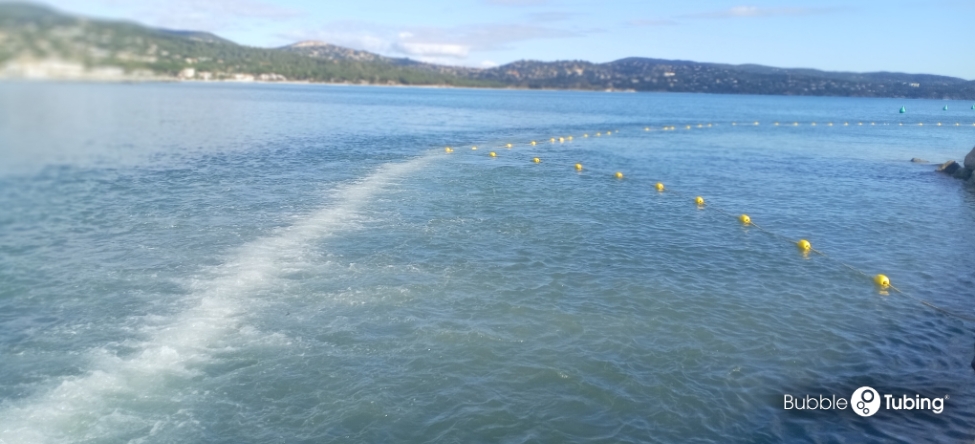
Many environmental factors influence how a bubble curtain might behave:
- Natural current direction
- Bathymetry (underwater topography)
- Water depth
- Wind-driven surface movement
- Debris type
A properly designed system works with these natural factors rather than trying to overpower them with more bubbles. The goal is to create a controlled upward current that guides debris. Too little air will not produce enough lift, while too much air can create turbulence that disrupts flow patterns and impacts directional control.
The Proof: Third-party Field and Flume Tank Test Results
Through years of R&D, CFD modelling, flume tank testing, and full-scale field deployments, we learned that bubble curtain performance is governed by much more than airflow alone. Research conducted with partners such as C-CORE demonstrated that parameters including bubble density, curtain spacing, diffuser geometry, water depth, currents, and plume structure all influence the hydraulic forces generated by a bubble curtain. In many cases, increasing airflow beyond an optimum point does not improve performance and can result in diminished efficiency. These findings have guided the continued development of Bubble Tubing® technology, allowing systems to be engineered for the specific application rather than simply maximizing the number of bubbles. This work has been documented through conference publications and research projects, including CFD studies presented at ASME’s Offshore Mechanics and Arctic Engineering Conference. Click here to read the study
Designing Smarter with CFD Modeling
To properly evaluate these complex interactions, we provide the option to incorporate Computational Fluid Dynamics (CFD) modeling into the system design process. Through our BubbleFlow CFD modeling services we can simulate how Bubble Tubing® systems interact with real-world conditions before installation.
This approach allows engineers and project teams to:
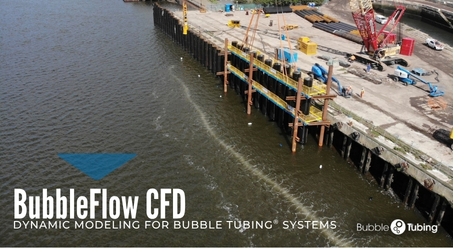
- Optimize tubing placement
- Determine the appropriate airflow
- Predict debris movement
- Improve system efficiency
Rather than relying on trial-and-error or increasing airflow, CFD modeling allows for data-driven design tailored to each site.
Looking to optimize your bubble curtain design? Contact us to learn how data-driven modeling can improve your next project.
Other Related Articles:
Bubble Curtains to Block Plastic Waste in Paris
Bubble curtain the multiple uses of Bubble Tubing®
Control of Invasive Species in Lake Tahoe